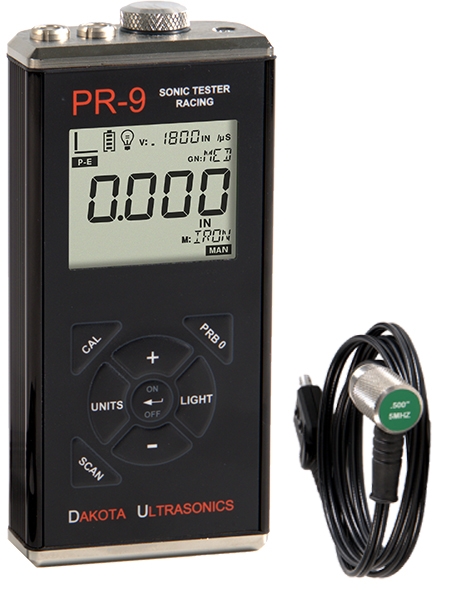
The Dakota Ultrasonics PR-9 Ultrasonic Thickness Gauge Z-309-0001 / Sonic Tester Racing with T-104-2120 Probe is commonly used to measure the thickness of cylinder walls, head ports, decks, chassis tubing, body panels, and windshields. An additional benefit is the dual element style of probe with the ability to locate blind surface corrosion or deterioration on the blind surface in the water jacket area prior to boring a cylinder or port. The high speed scan feature takes 100 measurements per second to save time when scanning a complete cylinder. Simply drag the probe from the bottom of the cylinder, at a given clock position in the cylinder, up to the deck area to locate the minimum thickness found. Scan can then be switched off and the user can find the exact location of the minimum thickness.
Extruded aluminum body with nickel-plated aluminum end caps (gasket sealed).
Keypad
Sealed membrane that is resistant to both water and petroleum products. Nine tactile-feedback keys.
Transducer
Dual element (transmit and receive). 1 to 10 MHz frequency range. Locking quick disconnect Lemo connectors. 4 foot cable. Custom transducers available for special applications
Power Source
Two 1.5V alkaline, 1.2V NiCad, or 1.5V Lithium AA cells. Typically operates for 45 hours on alkaline and 23 hours on NiCad. Low battery indicator on display. Auto shut-off after 5 minutes of inactivity
Display
Multi-function 7 segment 4.5 digit liquid crystal display with 0.500 in digit height. Two 0.125 in14 segment fields for labels and values, and one 7 segment field for labels and values. Additional icons to indicate features and modes. Backlight is selectable on/off/auto, and selectable brightness (Lo, Med, Hi) options. Bar graph indicates repeatability of measurement
Range
Measures from 0.025 to 36.00 inches (0.63 to 914.4 millimeters). Range dependent on material and transducer type
Automotive Applications
0.050 to 1.500 inches in casted materials
Units
English & Metric
Resolution
0.001 inches (0.01 millimeters)
Velocity Range
0.0120 to .7300 in/?s (305 to 18,542 m/sec)
PRF
200Hz
Display Update Rate
10Hz
High Speed Scan
Display the lowest measurement found during a scan. Scan speed at 100Hz. One or Two point calibration option
Certification
Factory calibration traceable to NIST & MIL-STD-45662A
Extruded aluminum body with nickel-plated aluminum end caps (gasket sealed).
Keypad
Sealed membrane that is resistant to both water and petroleum products. Nine tactile-feedback keys.
Transducer
Dual element (transmit and receive). 1 to 10 MHz frequency range. Locking quick disconnect Lemo connectors. 4 foot cable. Custom transducers available for special applications
Power Source
Two 1.5V alkaline, 1.2V NiCad, or 1.5V Lithium AA cells. Typically operates for 45 hours on alkaline and 23 hours on NiCad. Low battery indicator on display. Auto shut-off after 5 minutes of inactivity
Display
Multi-function 7 segment 4.5 digit liquid crystal display with 0.500 in digit height. Two 0.125 in14 segment fields for labels and values, and one 7 segment field for labels and values. Additional icons to indicate features and modes. Backlight is selectable on/off/auto, and selectable brightness (Lo, Med, Hi) options. Bar graph indicates repeatability of measurement
Range
Measures from 0.025 to 36.00 inches (0.63 to 914.4 millimeters). Range dependent on material and transducer type
Automotive Applications
0.050 to 1.500 inches in casted materials
Units
English & Metric
Resolution
0.001 inches (0.01 millimeters)
Velocity Range
0.0120 to .7300 in/?s (305 to 18,542 m/sec)
PRF
200Hz
Display Update Rate
10Hz
High Speed Scan
Display the lowest measurement found during a scan. Scan speed at 100Hz. One or Two point calibration option
Certification
Factory calibration traceable to NIST & MIL-STD-45662A
Warranty
5 year limited
Product Features
The PR-9 sonic tester is used to measure the thickness of cylinder walls, head ports, decks, chassis tubing, body panels, and windshields.
Factory calibration traceable to NIST & MIL-STD-45662A
Range: Measures from 0.025 to 36.00 inches (0.63 to 914.4 millimeters). Range dependent on material and transducer type